

Hello Golden Puppers!
Let’s say you lean in to give a kiss and notice your golden’s gums look thicker than last month. Or worse, the teeth look shorter. Like the gums are slowly eating the smile.
That overgrowth has a name. Vets often call what they see gingival enlargement. If a biopsy shows extra normal gum cells stacked the usual way, the histology label is gingival hyperplasia. Same owner problem either way: too much gum tissue, covering more tooth than it should, trapping junk that should not be there.
This is not a “cute chubby gums” thing. Those false pockets hold plaque, hair, and food. Inflammation climbs. Real periodontal disease and pain can follow. Teeth can be at risk.
Why this shows up in goldens
Any dog can get gum overgrowth. Boxers are the classic high-risk breed, and that is where a lot of the genetics research sits right now, including work at Cornell funded through the AKC Canine Health Foundation.
Goldens show up on some veterinary dentistry breed lists. They do not show up on every one. There is no Golden-specific gene test, and there is no solid published prevalence number for our breed. What we can say honestly: it happens in goldens, and we should take mouth changes seriously.
Three big drivers, and they can stack:
1. An over-the-top response to plaque and chronic gum inflammation. Some dogs recede. Predisposed dogs proliferate.
2. Genetics and breed tendency, strongest and best studied in Boxers, possible in other breeds including some Retrievers.
3. Medications. Cyclosporine (common for itchy atopic dogs) is the big one in vet practice. Calcium channel blockers like amlodipine are another. Certain anticonvulsants can do it too.
If your golden is on long-term cyclosporine for allergies, put gum checks on your radar. A published case series even includes a Golden Retriever whose owners said her teeth looked like they were disappearing while she was on cyclosporine.
What you might notice at home
- Gums that look thicker, redder, or “puffy”
- Teeth that look shorter because tissue is climbing the crown
- A focal lump on the gumline, or thickening across a whole section of the mouth
- Bad breath that will not quit
- Drooling, sometimes tinged with blood
- Bleeding when they chew toys or when you brush
- Soft-food preference, or backing off hard chews
- Pawing at the mouth or rubbing the face
Early changes often start subtle, sometimes at the lower front teeth. Advanced cases can bury most of a crown. Gum overgrowth can look a lot like other oral masses: peripheral odontogenic fibroma (the old “fibromatous epulis”), other growths, and yes, cancer.
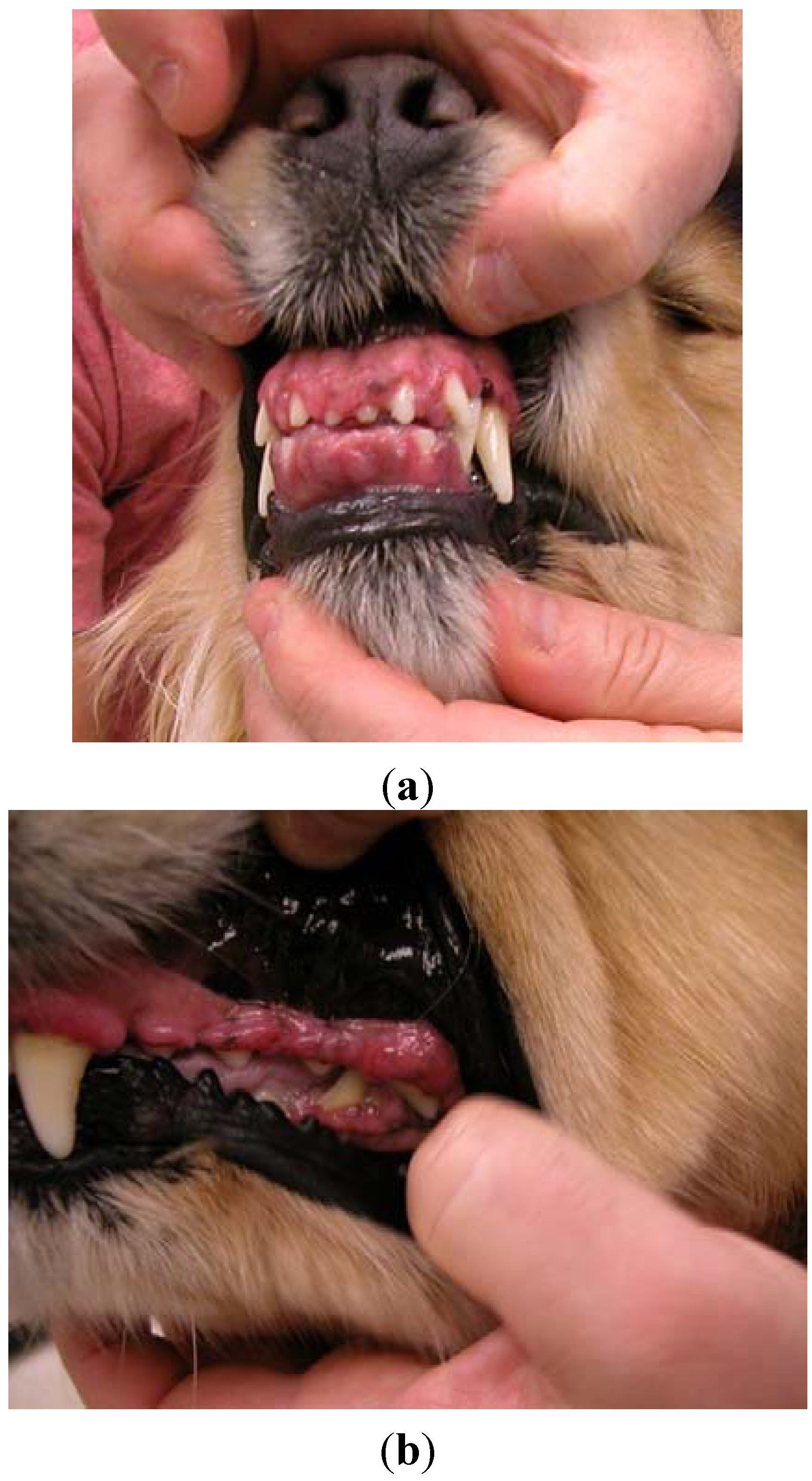
Board-certified veterinary dentists push for a full dental under anesthesia when the mouth needs real work: probing, charting, full-mouth radiographs, and often biopsy of the tissue they remove. Appearance alone is not a diagnosis. One published Boxer case that looked like classic familial enlargement still had other tumors in the mix once histology came back.
Also bring the med list. If a drug is feeding the problem, your vet may be able to adjust it safely. Do not stop heart or seizure meds on your own.
What treatment usually looks like
For mild cases tied to a drug, changing the medication (when the prescribing vet says it is safe) can help a lot.
For significant overgrowth, surgery is the main stay. The vet trims the excess (gingivectomy) and reshapes the gumline (gingivoplasty) so those false pockets go away and a more normal margin comes back. That almost always happens with a professional cleaning under anesthesia.
Aftercare is important: pain meds as prescribed, soft food for about two weeks, no hard toys until things heal, then back to brushing and the schedule your vet sets.
Here is the hard truth for genetically predisposed dogs. Surgery helps comfort and function. It often does not permanently “cure” the tendency. Plaque control after surgery is what slows regrowth. Some dogs need the procedure more than once over a lifetime.
In select cyclosporine cases, vets have used azithromycin under supervision with promising results in a small case series. However, that is a vet decision and studies are mixed on how complete the fix is.
What actually helps at home
Daily toothbrushing with dog-safe toothpaste is still the biggest way to control it. Plaque is the fuel. Less fuel, less inflammation for predisposed gums to overreact to.
Regular oral exams and professional cleanings matter more if your golden already had overgrowth once. VOHC-accepted dental diets and dental chews can help as add-ons. Just keep in mind they are not a substitute for a brush and a real dental plan.
Skip the myths:
- “It is only cosmetic.” No.
- “Chews alone will prevent it.” No.
- “If it looks like hyperplasia, skip the biopsy.” No.
- Human toothpaste, random essential-oil rinses, or DIY chemistry. Hard no.
When to call sooner rather than later
Same week is fine for: new or progressive thickening, teeth looking shorter, stubborn bad breath, light gum bleeding, drooling, soft-food preference.
Same day, or ER if it is after hours, for: refusing food or water, obvious oral pain, heavy or ongoing bleeding, a mass that is growing fast or looks ulcerated and nasty, facial swelling, fever or lethargy with mouth trouble, trauma that will not stop bleeding.
A focal lump that looks like a tumor is not “wait and see until the next annual.”
If you have sat in a dental consult with a golden and heard any version of “the gums are taking over,” tell me what your vet recommended and what actually worked afterward.
As always, The Golden Pupper is not a replacement for professional veterinary advice. Always consult your veterinarian about your golden’s mouth, meds, and dental plan.
*Please note, as an Amazon Associate I earn from qualifying purchases.
References
American Veterinary Dental College. (n.d.). *Nomenclature*. https://avdc.org/avdc-nomenclature/
Bellows, J. (n.d.). *The ABCs of veterinary dentistry: G is for gingiva*. dvm360. https://www.dvm360.com/view/abcs-veterinary-dentistry-g-gingiva
Cornell University College of Veterinary Medicine. (n.d.). *Identification of genetic risk factors for gingival enlargement in Boxers*. https://www.vet.cornell.edu/research/awards/identification-genetic-risk-factors-gingival-enlargement-boxers
Diesel, A., & Moriello, K. (2015). Medical management of cyclosporine-induced gingival overgrowth using oral azithromycin in six dogs. *Veterinary Sciences, 2*(1), 13–22. https://doi.org/10.3390/vetsci2010013
Lewis, J. R. (n.d.). *What to do when gums overgrow their boundaries*. Veterinary Practice News. https://www.veterinarypracticenews.com/what-to-do-when-gums-overgrow-their-boundaries/
Sauvé, C. (n.d.). *How I approach gingival enlargement in the dog*. Royal Canin Academy. https://academy.royalcanin.com/en/veterinary/how-i-approach-gingival-enlargement-in-the-dog
VCA Animal Hospitals. (n.d.). *Gingival hyperplasia*. https://vcahospitals.com/know-your-pet/gingival-hyperplasia